
C
Climber35369693067August 2026
Luz
Irrepetible e Inolvidable. Sin duda volveremos. Magnífico servicio ❤️
Verified Tripadvisor review
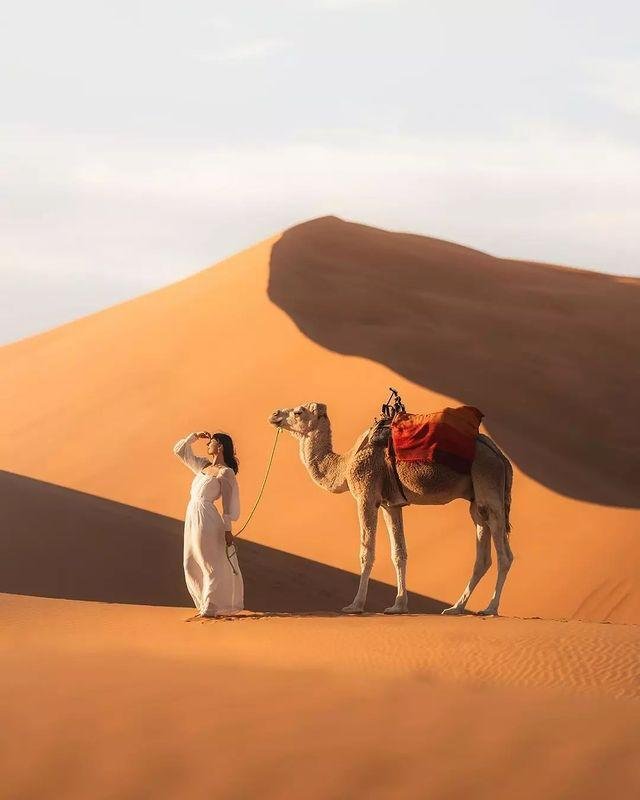
Three weeks, the whole country · Tangier, Chefchaouen, Fes, the Sahara, Marrakech & the coast
This 20 day Morocco tour from Casablanca is our most complete journey: a three-week loop that starts and ends at Casablanca airport and covers almost every corner of the country. You travel north to Rabat, Asilah and Tangier, spend two nights in the blue city of Chefchaouen, visit Volubilis, Meknes and Fes, cross the Middle Atlas to the Sahara for 2 nights in Merzouga, follow the Todra and Dades Gorges and the Road of a Thousand Kasbahs to Aït Ben Haddou, then enjoy Marrakech, the High Atlas and the Atlantic coast from Essaouira to El Jadida. It is one of our Morocco tours from Casablanca.
This Morocco grand tour from Casablanca is the longest of our Morocco customized travel itineraries, and one of the few that drive through the Ziz Gorges, the most dramatic part of the Ziz Valley, Morocco’s great river of palms.
With 20 days in Morocco, there are no rushed days: most drives are between 2 and 5 hours, and you have full days in Chefchaouen, Fes, the desert, Marrakech and Essaouira. This 3 week Morocco tour is private, with your own vehicle and English-speaking driver-guide, and every day can be adjusted to your interests.
The highlights of this grand Morocco tour include 9 UNESCO World Heritage Sites (Rabat, Tetouan, Volubilis, Meknes, the medinas of Fes, Marrakech and Essaouira, Aït Ben Haddou and El Jadida), a sunset camel trek and a luxury desert camp in Merzouga, Gnawa music in Khamlia and fresh seafood in Oualidia.
For more planning help, read our 14 days in Morocco itinerary, our guide Casablanca to Marrakech: best Morocco travel itineraries and the best time to visit Morocco.
Prepare for the journey of a lifetime. This 20 days Morocco itinerary from Casablanca takes you from the Atlantic to the Mediterranean, over the Rif, the Middle Atlas and the High Atlas, into the Sahara and back along the coast.
Because the tour is long, the pace is slow: two nights in Chefchaouen, Fes, Merzouga, Marrakech (three) and Essaouira, and short driving days in the south, with nights near the Todra Gorge, in the Dades Valley and inside Aït Ben Haddou.
Along the way, enjoy Cap Spartel and the Caves of Hercules, Roman ruins, imperial palaces, cedar forests with Barbary macaques, camel rides in the dunes, nomad visits, dramatic canyons, kasbahs, Berber villages in the Atlas and the oyster lagoon of Oualidia.
This Casablanca round trip is ideal for travelers who want to see the whole country in one trip, without packing and unpacking every day.
Start and finish at Casablanca airport, with the Hassan II Mosque on Day 1.
Rabat, Asilah and Tangier on the Atlantic and Mediterranean coasts.
Cap Spartel and the Caves of Hercules.
Two nights in Chefchaouen, with the Akchour waterfalls.
Roman Volubilis and imperial Meknes.
A guided day in the Fes medina.
Ifrane and the Azrou cedar forest.
Two nights in Merzouga: camel trek, luxury desert camp and a 4×4 excursion.
Gnawa music in Khamlia and a visit to nomad families.
A night near the Todra Gorge and a day in the Dades Gorges.
The Valley of Roses, Skoura and Ouarzazate.
A night inside Aït Ben Haddou and the Telouet Kasbah.
Three nights in Marrakech, with a guided tour and an Atlas Mountains day.
Two nights in Essaouira on the Atlantic coast.
Oualidia lagoon and the Portuguese City of El Jadida.
Private vehicle and English-speaking driver-guide for all 20 days.
Your 20 day Morocco tour from Casablanca begins at Mohammed V International Airport, where your private driver-guide welcomes you with a warm smile and helps with your luggage. After a short drive into Casablanca, Morocco’s largest city and economic heart, you visit the magnificent Hassan II Mosque. Built partly over the Atlantic Ocean, it has one of the tallest minarets in the world and is one of the few mosques in Morocco open to non-Muslim visitors on guided tours. Admire its carved cedar ceilings, marble floors and fine zellige tilework. Afterwards, relax with a walk along the Corniche, the seaside promenade lined with cafés and beaches, and enjoy the fresh ocean breeze. This gentle first day gives you time to rest after your flight, change money and settle into the rhythm of Morocco before the great journey begins tomorrow.
After breakfast, drive north along the coast to Rabat, Morocco’s elegant capital and a UNESCO World Heritage Site. Visit the unfinished Hassan Tower and the Mausoleum of Mohammed V, guarded by royal horsemen, then wander through the peaceful blue-and-white lanes of the Kasbah of the Udayas, with views over the Bou Regreg River and the ocean. Continue north to Asilah, a small whitewashed town on the Atlantic whose medina walls are decorated with colourful murals painted by artists during its summer festival. Take time for a stroll and a seafood lunch by the sea. In the late afternoon, arrive in Tangier, the legendary port city where Africa meets Europe and the Atlantic meets the Mediterranean. Check into your riad or hotel and enjoy an evening walk through the lively streets of the medina. Tangier has inspired writers and artists for over a century.
This morning, drive to Cap Spartel, the lighthouse on the northwestern tip of Africa, where you can see the Atlantic Ocean and the Mediterranean Sea meet. Nearby, visit the Caves of Hercules, famous for their sea opening shaped like the map of Africa and linked to ancient legends. Return through Tangier for a short visit to the kasbah and its viewpoints over the Strait of Gibraltar. Then drive east to Tetouan, whose white medina, a UNESCO World Heritage Site, shows a strong Andalusian influence in its architecture and crafts. In the afternoon, the road climbs into the green Rif Mountains, passing olive groves and small villages, to Chefchaouen, the famous blue city. Settle into your riad and take a first walk through the painted alleys as the evening light turns the blue walls even more beautiful. Dinner tonight is at your riad.
Today is yours to enjoy Chefchaouen at a relaxed pace, one of the great advantages of a 20 day itinerary. In the early morning, when the lanes are quiet, explore the blue medina, the red-walled kasbah and the shady Outa el Hammam square, then follow the stream to the spring of Ras El Maa, where locals still wash clothes in the cold mountain water. Nature lovers can take an optional half-day trip to the Akchour waterfalls in Talassemtane National Park, walking along the river to cascades and the natural rock arch known as God’s Bridge. In the late afternoon, climb the path to the Spanish Mosque for a sunset view over the whole blue city and the Rif Mountains. Read our Chefchaouen travel guide for more ideas on what to see, where to eat and what to buy.
After breakfast, leave the Rif Mountains and drive south through rolling farmland to Volubilis, the best-preserved Roman ruins in Morocco and a UNESCO World Heritage Site. Walk among the triumphal arch, the basilica and the houses decorated with beautiful floor mosaics, with views across olive groves. Next door, see the holy hilltop town of Moulay Idriss Zerhoun, one of the most important pilgrimage sites in the country. Continue to Meknes, the imperial city built by Sultan Moulay Ismail, to admire the monumental Bab Mansour gate, the royal granaries and the lively Lahdim square. In the late afternoon, arrive in Fes, the spiritual and cultural capital of Morocco, and check into a traditional riad in the old city. Enjoy a quiet dinner and rest before tomorrow’s full day exploring one of the oldest medinas in the world. Rest well tonight in Fes.
Today a licensed local guide shows you the Medina of Fes, a UNESCO World Heritage Site and the largest car-free urban area in the world, with more than 9,000 narrow lanes. Begin at the golden gates of the Royal Palace and the old Jewish quarter, then enter Fes el-Bali through the blue Bab Boujloud gate. Visit the Bou Inania Madrasa with its carved stucco and cedar wood, pass the area around the Al-Qarawiyyin mosque and university, founded in 859, and climb to a terrace above the famous Chouara tanneries, where leather is still dyed by hand. Meet potters, weavers, coppersmiths and embroiderers in their workshops and learn how their crafts have been passed down for centuries. End the day with a panoramic view over the old city from the Merenid Tombs as the call to prayer echoes across the rooftops.
After breakfast, leave Fes and climb into the cool Middle Atlas Mountains. Stop in Ifrane, a clean alpine-style town with red roofs and parks, often called the “Switzerland of Morocco” and a popular ski area in winter. Continue to the Azrou cedar forest, where tall Atlas cedars shelter families of wild Barbary macaques, a great moment for photos. The road then crosses high plateaus dotted with nomad tents and grazing sheep, with wide views of the mountains. In the afternoon, arrive in Midelt, the apple capital of Morocco, at the foot of the often snow-capped Jbel Ayachi. This short driving day splits the long road from Fes to the Sahara in two, so you arrive in the desert rested. Enjoy a relaxed evening and a traditional dinner at your hotel or kasbah. Keep a warm layer handy, as the plateaus can be cool.
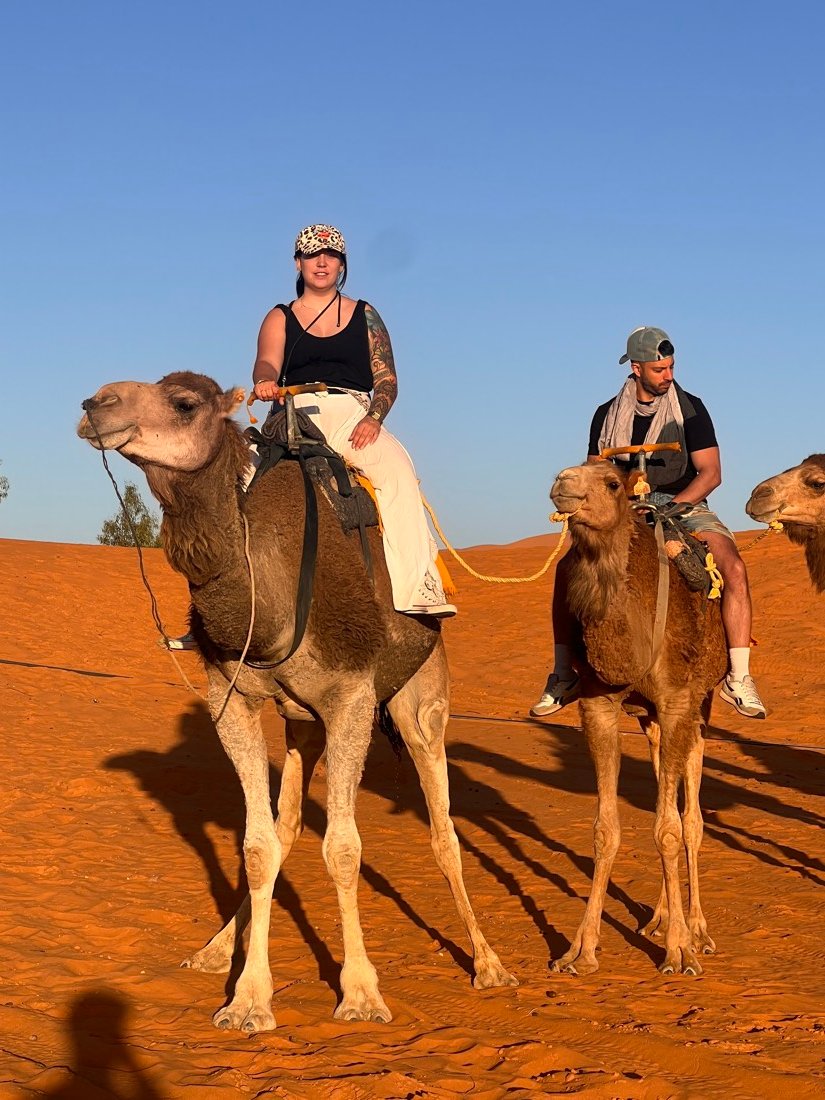
Today the scenery changes dramatically. Drive south through the deep Ziz Gorges, carved by the river through red and ochre cliffs, and follow the Ziz Valley, a green ribbon of date palms and earthen villages, past Errachidia and the fossil town of Erfoud. As the landscape turns golden, the dunes of Erg Chebbi appear on the horizon, rising up to about 150 metres. Arrive in Merzouga, on the edge of the Sahara, where your camel caravan is waiting. In the late afternoon, ride into the dunes for a magical Erg Chebbi camel trek and watch the sunset paint the sand in shades of orange and red. Arrive at your luxury desert camp for mint tea, a delicious dinner, Berber drums around the campfire and a night under a sky full of stars. It is a night you will never forget.
Wake up early to climb a dune and watch the sunrise over the Sahara, one of the most unforgettable moments of the trip. After breakfast, spend the day exploring the desert by 4×4 with your driver-guide. Visit a nomadic family in their tent to learn how they live with their animals in this harsh environment, and share a glass of tea. Continue to Khamlia village, where descendants of West African families perform traditional Gnawa music, recognised by UNESCO. Drive across the black desert, old mining areas and seasonal lakes around Erg Chebbi. In the afternoon, enjoy free time to rest by the pool, try sandboarding on the dunes, or book an optional quad bike ride. Compare desert trips in our guide to the best Morocco desert tours. Tonight you stay in a comfortable hotel near the dunes. Dinner is included.
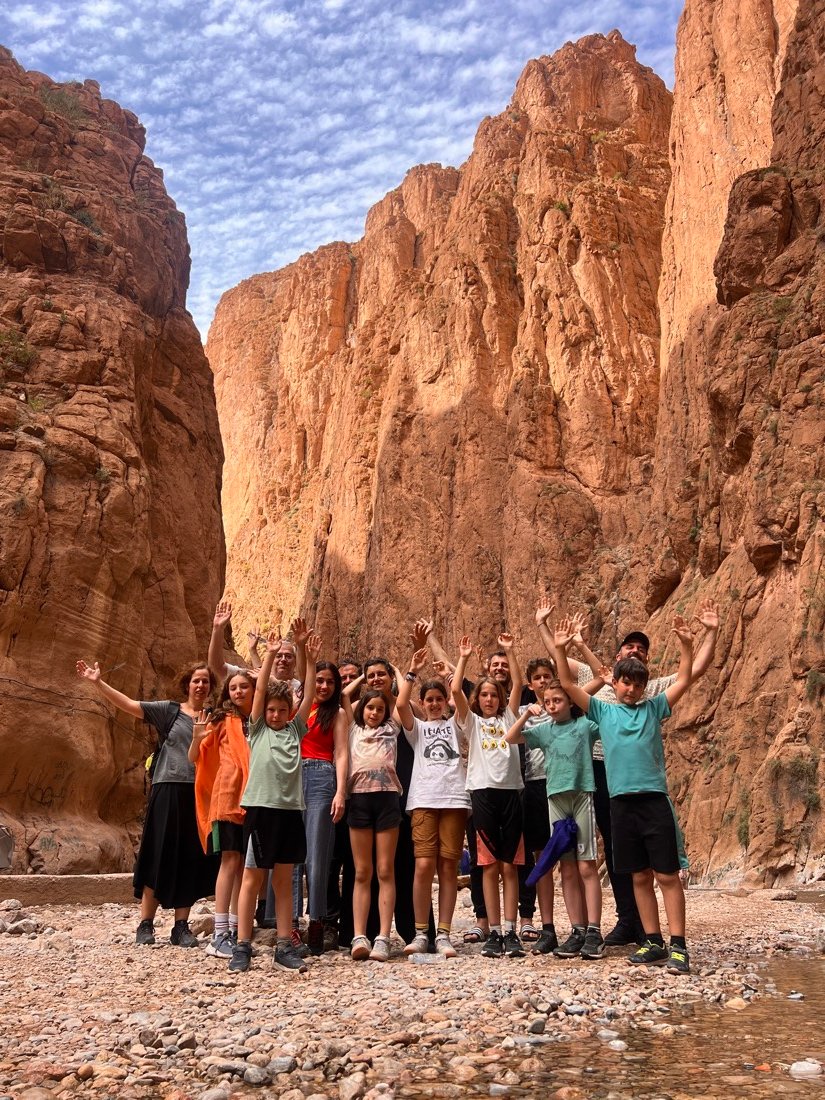
After breakfast, leave the dunes and drive to Rissani, the historic capital of the Tafilalet region and the birthplace of the ruling Alaouite dynasty. If it is market day, explore the traditional souk with its spices, dates, donkeys and handmade crafts. Continue west through desert landscapes to Alnif, famous for its fossils, especially trilobites hundreds of millions of years old. The road then follows ancient caravan routes past palm oases and earthen villages to Tinghir, surrounded by one of the largest palm groves in Morocco. In the afternoon, walk between the 300-metre-high limestone walls of the Todra Gorge, where the river flows over the stones and climbers test the cliffs. Spend the night close to the gorge, when the day visitors have gone, and enjoy the peaceful sound of the river. Dinner is served at your guesthouse near the gorge tonight.
A slower day in the mountains. After breakfast, drive to Boumalne Dades and up the spectacular Dades Gorges, along the famous winding road with its tight hairpin bends and dramatic viewpoints. With your guide, take an easy walk among the red rock formations known as the Monkey Fingers, shaped by wind and water over thousands of years, and through small Berber villages with fig and almond trees. Stop for mint tea in a café overlooking the valley and watch daily life in the fields below. In the afternoon, relax at your hotel or riad in the Dades Valley, take photos of the kasbahs glowing in the late light, or simply rest after the long days in the desert. This gentle day is one of the joys of a 20 day Morocco tour, giving you time to enjoy the landscapes without rushing.
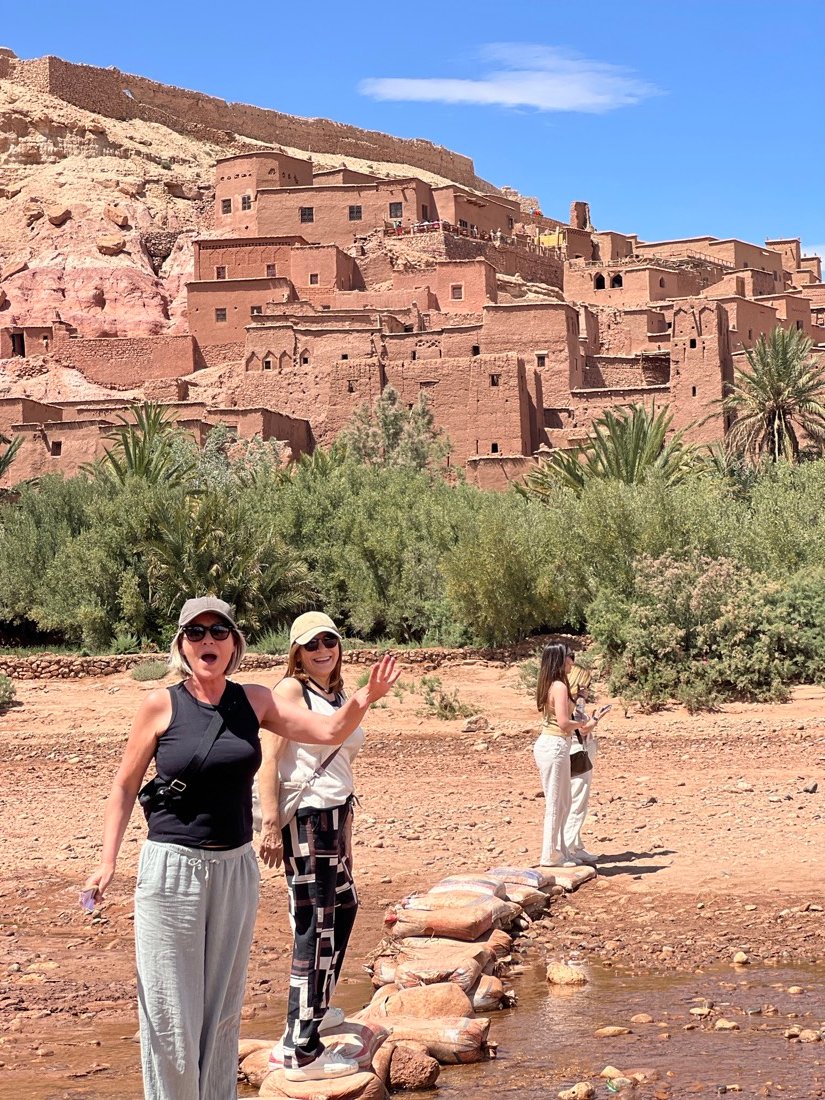
Today you follow the famous Road of a Thousand Kasbahs west. Drive through the Valley of Roses at Kelaat M’Gouna, where rose water, rose oil and creams are made from the small pink roses grown in the hedges, and stop at a cooperative. Continue to the palm oasis of Skoura, full of old earthen kasbahs, then Ouarzazate, Morocco’s film capital, where you can visit the Taourirt Kasbah or the Atlas Film Studios. In the late afternoon, arrive at the Ksar of Aït Ben Haddou, a UNESCO World Heritage Site and one of the best-known fortified villages in Morocco, seen in many films and series. Sleeping in a kasbah guesthouse here lets you see the ksar glow at sunset and again at sunrise, after the crowds have gone. Enjoy dinner on a terrace with views of the old village.
After breakfast, take the scenic back road through the green Ounila Valley, with its terraced fields and earthen villages, to Telouet Kasbah, the former palace of the powerful Glaoui family. Inside, admire the beautifully painted cedar ceilings, carved stucco and colourful zellige tiles. Then join the main road and cross the High Atlas over the Tizi n’Tichka Pass, at about 2,260 metres, the highest main road pass in Morocco, with sweeping views over Berber villages and valleys. Stop at viewpoints for photos as the road winds down towards the plains. In the afternoon, arrive in Marrakech, the Red City, and check into your riad inside the medina. Read about this beautiful road and its stops in our guide Marrakech to Merzouga. In the evening, take your first walk to the lively Jemaa el-Fna square. The contrast with the desert is striking.
Today a licensed local guide shows you the highlights of the Medina of Marrakech, a UNESCO World Heritage Site. Start at the Koutoubia Mosque, whose 12th-century minaret is the symbol of the city, then visit the Bahia Palace, with its peaceful courtyards, painted ceilings and gardens. See the Saadian Tombs, decorated with marble and fine stucco, and the Ben Youssef Madrasa, one of the most beautiful buildings in Morocco. Wander through the colourful souks of spices, lanterns, leather, carpets and jewellery, and learn how to bargain like a local. In the afternoon, enjoy free time to visit the Jardin Majorelle or relax in a traditional hammam. In the evening, return to Jemaa el-Fna, recognised by UNESCO, to enjoy the food stalls, musicians and storytellers as the square comes alive. Your guide also shares stories about the history of each monument along the way.
Escape the city for a day in the High Atlas Mountains. Drive south across the plains and through the market town of Asni to the Imlil Valley, the gateway to Mount Toubkal, North Africa’s highest peak at 4,167 metres. Meet a local Berber guide for a gentle walk along mountain paths, past walnut and apple orchards, terraced fields and stone houses, to the village of Aroumd. Stop for mint tea in a Berber home and learn about daily life in the mountains, where traditions have changed little over the centuries. The fresh air and quiet villages are a perfect contrast to the busy souks of Marrakech. Return to the city in the late afternoon for a free evening. For more ideas in the Red City, see our list of the best things to do in Marrakech, from gardens to rooftop restaurants.
After breakfast, leave Marrakech and drive west across the plains into argan country, where twisted argan trees grow only in this region of Morocco. If you are lucky, you will see the famous goats climbing in the branches. Stop at a women’s cooperative to learn how argan oil is pressed by hand and taste amlou, a delicious spread of argan oil, almonds and honey. In the early afternoon, arrive in Essaouira, the old Mogador, a relaxed port town on the Atlantic coast with a UNESCO-listed medina, white houses with blue shutters and a lively fishing port full of blue boats. Check into your riad and take a first walk along the ramparts at sunset, when the seagulls circle above the harbour and the light turns golden over the ocean. Dinner is free tonight, ideal for trying fresh seafood.
Today is a free day to enjoy Essaouira at your own pace, perfect after the long journey across the country. Walk along the Skala de la Ville ramparts, lined with old cannons, and explore the art galleries and woodwork shops of the medina, famous for thuya wood carving. In the morning, watch the fishermen bring in their catch at the port and choose fresh fish to be grilled for lunch at the harbour stalls. The wide sandy beach is ideal for a long walk, a camel or horse ride, or surfing and kitesurfing thanks to the strong Atlantic winds. In the afternoon, relax in a café on the main square or treat yourself to a hammam. Essaouira is also known for the Gnaoua World Music Festival, held each summer, and its laid-back, artistic atmosphere makes it a favourite stop for travelers.
After breakfast, follow the Atlantic coast north on a scenic road between the ocean and farmland. Stop in Safi, known for its pottery workshops and colourful ceramics, and visit the potters’ hill where artisans shape and fire clay in traditional kilns. You can also see the old Portuguese fortress overlooking the sea. Continue north to Oualidia, a peaceful village built around a calm lagoon protected from the ocean waves, famous across Morocco for its oysters and seafood. Enjoy a long seafood lunch by the water, take a boat ride on the lagoon or relax on the sandy beach. Oualidia is also a good place for birdwatching, with flamingos and herons in the season. In the evening, watch the sun set over the Atlantic from your hotel or guesthouse and enjoy one last quiet night on the coast. Life here moves slowly.
After breakfast, drive north along the coast to El Jadida, the old Portuguese fortress town of Mazagan, now a UNESCO World Heritage Site as the Portuguese City of El Jadida. Walk along the massive ramparts with views of the ocean and the port, and visit the famous underground Portuguese Cistern, where light falls through a single opening in the roof onto a thin layer of water, creating beautiful reflections that have appeared in several films. Explore the small streets of the old city, with its church and Manueline architecture. In the afternoon, continue to Casablanca and check into your hotel. Enjoy a last evening by the ocean, perhaps with dinner on the Corniche or a visit to the Habous quarter for last-minute souvenirs, as you remember the many moments of your journey across Morocco. Dinner is included tonight.
After a final breakfast in Morocco, your private driver-guide takes you to Mohammed V International Airport for your flight home, completing your 20 days in Morocco. Depending on your flight time, you may have a few free hours to visit the Habous quarter, buy souvenirs, or take a last walk along the Corniche. Over three weeks, you have traveled from the Mediterranean to the Sahara, through the Rif, the Middle Atlas and the High Atlas, from blue Chefchaouen and ancient Fes to golden Merzouga, the kasbahs of the south, vibrant Marrakech and the Atlantic coast. We hope you leave with wonderful memories, new friends and a piece of Morocco in your heart. For future trips, read how many days you need in Morocco, and come back soon to discover even more of our homeland. Thank you for traveling with our family.
Accommodation includes a mix of standard, mid-range, and luxury hotels, riads, and desert camps depending on your budget. In Merzouga, you can choose between a standard camp or a luxury desert camp with private tents and upgraded comfort for both nights.
Prices depend on travel season, group size, and accommodation category. Discounts are available for larger groups. For an exact quote, please contact us with your travel details.
Verified Tripadvisor review
Verified Tripadvisor review
Verified Tripadvisor review
Yes. It is a fully private tour for you and your travel companions, with your own vehicle and English-speaking driver-guide for all 20 days, plus local guides in Fes, Marrakech and Imlil.
The tour starts and finishes at Casablanca Mohammed V International Airport, so you can book a simple return flight. Pickup from a Casablanca hotel is also possible.
It depends on your time and interests. This tour is our most complete journey, a three-week Casablanca round trip with Tangier, two nights in Chefchaouen, Fes, 2 nights in Merzouga, the gorges, a night in Aït Ben Haddou, Marrakech and the Atlantic coast. Among our other options, the 5-day desert tour from Casablanca to Marrakech offers the fastest route, with one night in the desert; the 6-day desert trip from Casablanca to Marrakech adds a guided tour of Marrakech; the 7-day Morocco tour from Casablanca to Marrakech adds a night in Rabat; the 8-day Morocco tour from Casablanca to Marrakech adds a guided day in Fes; the 9-day Morocco tour from Casablanca to Marrakech and the 9-day Sahara desert trip from Casablanca offer 2 nights in Merzouga; the luxury 10-day Morocco tour from Casablanca offers upgraded hotels; and the 15-day Morocco tour from Casablanca offers a 2-week round trip with Marrakech and Essaouira.
Yes. Besides this tour, we run private Morocco tours from Marrakech, Fes, Tangier, Agadir and Errachidia, as well as day trips from Marrakech. Not sure which city to start from? Read our guide on where to start your Morocco tour.
Not at all. Twenty days let you see the north, the imperial cities, the Sahara, the southern gorges, Marrakech and the coast at a relaxed pace, with several two- and three-night stays. If you have two weeks, see our 14 days in Morocco itinerary.
Most days have 2 to 5 hours on the road. The longest are Day 2, Casablanca to Tangier via Rabat and Asilah (about 340 km), and Day 5, Chefchaouen to Fes via Volubilis and Meknes (about 250 km plus visits). Days 4, 6, 9, 14, 15 and 17 have little or no long driving.
Two nights in Merzouga: the first in a luxury desert camp in the Erg Chebbi dunes after your camel trek, and the second in a hotel near the dunes after a full-day 4×4 excursion.
Yes. We can end the tour in Marrakech after Day 15, or skip the coast and finish wherever suits your flights. Every itinerary is customizable.
The price depends on the number of travelers, travel dates and accommodation level (standard, mid-range or luxury). Larger groups pay less per person. Send us your dates and group size for a personalized quote.
Spring (March to May) and autumn (September to November) are the best seasons, with warm days, pleasant desert nights and open mountain passes. See the best time to visit Morocco.
Yes. The slow pace, short driving days and multi-night stays make it one of our most comfortable tours for families with children and older travelers.
Yes. Vegetarian and most dietary requirements can be arranged. Please tell us in advance.
Yes. Morocco is a welcoming country, and you travel with a local driver-guide the whole time. Read our guides on whether Morocco is safe for Americans and for female travelers.
 15 Days
 9 Days
 10 Days