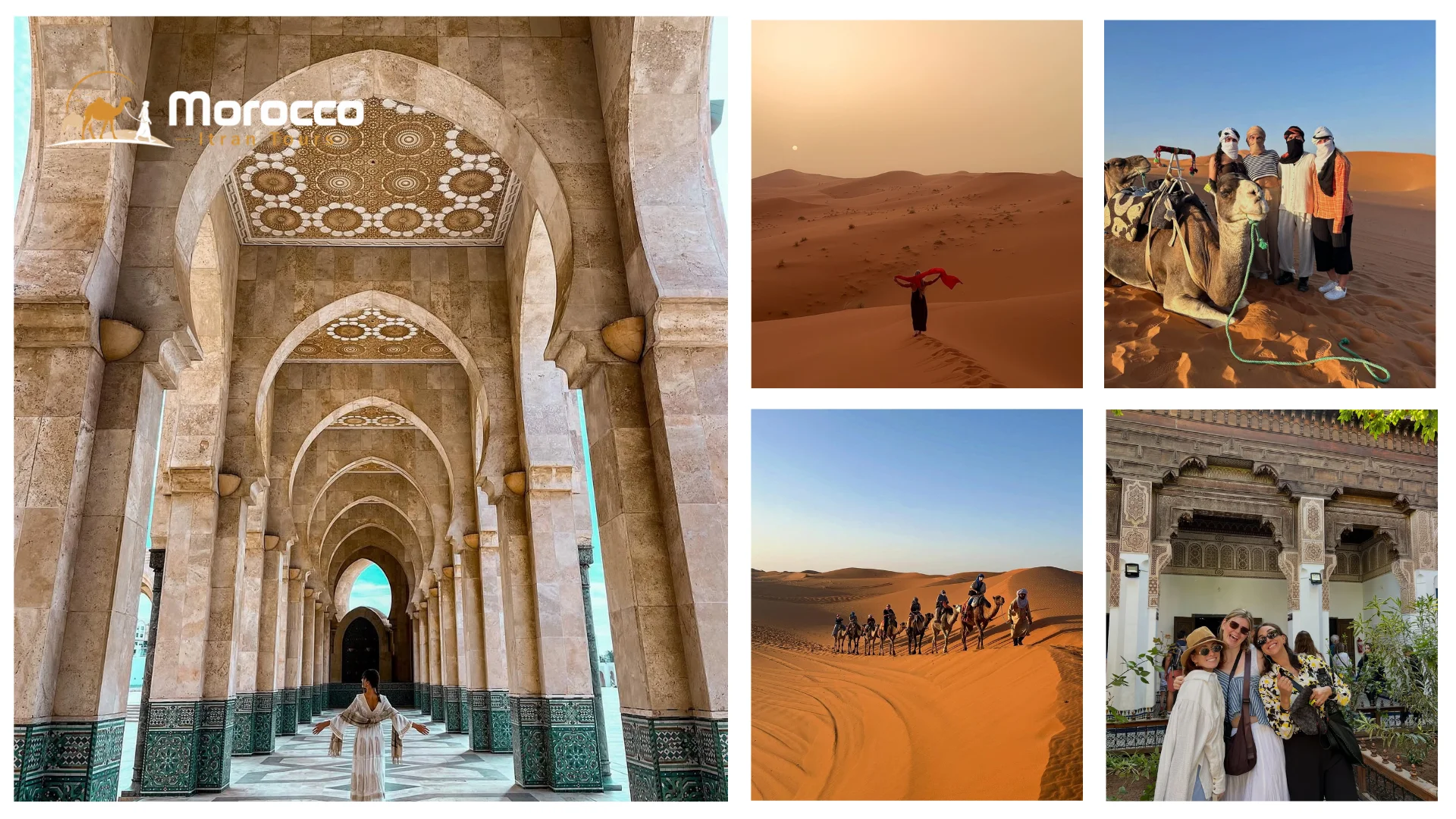




Here’s the thing about planning a Morocco trip: the hard part was never finding good places to go. It’s cutting the list down. Blue-washed mountain towns, imperial cities with medinas that seem to fold in on themselves, dunes that go gold at sunset, a rugged Atlantic coast, mountain passes that make you ask the driver to pull over every ten minutes. It’s a small country by some standards, and somehow almost none of it feels like filler.
So instead of just running through every town in a guidebook, here’s a look at the best Morocco destinations, the ones that genuinely earn their spot on any best Morocco itinerary, and why each one is worth the drive.
Most people’s Morocco trip starts or ends in Marrakech, and once you’re there, you get why it’s the name everyone knows. The souks are overwhelming, genuinely, in the good way, spices, leather, lamps, endless textiles, all packed into lanes that seem to double back on themselves no matter which way you turn. The Bahia Palace and the Saadian Tombs give you a quieter, more architectural side of things when you need a break from the noise. And Jemaa el-Fnaa Square at night is its own kind of chaos, food stalls, musicians, storytellers, and what feels like the entire city out at once.
If you’re only weighing the best places to visit in Marrakech, these three are the ones to build your day around. It’s a lot, not everyone loves that much intensity for days on end, but it’s hard to leave Morocco without spending at least a couple of days here.
Good for: souks and shopping, food, architecture, nightlife, a guided city tour
If Marrakech is the showpiece, Fes is more like the soul of the place. The old medina is one of the largest car-free urban areas left in the world, and honestly, it feels medieval in parts, narrow alleys, centuries-old madrasas, workshops still doing things the exact way they always have.
Everyone talks about the Chouara Tanneries (ask for a sprig of mint when you get there, and you’ll immediately understand why), but really the whole medina rewards slow, unhurried wandering with a guide who genuinely knows the place. Al Quaraouiyine, often called the oldest university in the world, and the tilework at Bou Inania Madrasa are both worth carving out real time for, not just a quick photo stop. If you’re researching things to do in Fes, Morocco, these are the landmarks to prioritize.
Good for: history, traditional crafts, architecture, a full guided day, travelers who’d rather go deep than fast
Chefchaouen genuinely lives up to the photos, which isn’t always true of famous places. The old town is washed in blue, everything from pale sky tones to deep indigo, and walking through it feels different from anywhere else in the country. Quiet. Photogenic without even trying. A real change of pace after the intensity of the bigger cities.
It sits up in the Rif Mountains, and honestly the setting is half the appeal, cool air, green hills, a slower rhythm to the whole town. Climb up to one of the viewpoints above the medina and you’ll get that shot of blue rooftops against the mountains you’ve probably already scrolled past on Instagram. If you’ve been wondering is Chefchaouen worth visiting, this is really the argument for it: nowhere else in Morocco looks or feels quite like it.
Good for: photography, relaxed walking, a mountain-town pace, solo travelers
Ask people what they remember most from Morocco, and it’s almost always this: riding out on a camel into the Erg Chebbi dunes as the light turns gold, then sitting outside a desert camp under a sky with more stars in it than you knew existed.
Merzouga desert Morocco trips are your jumping-off point for all of it. From there you can do a short camel trek, or spend a full day out by 4×4, visiting nomadic families, hearing Gnawa music in the nearby village of Khamlia, or just getting up before dawn to watch the sun come over the dunes. For anyone comparing the best places to visit in the Sahara Desert Morocco, Merzouga and Erg Chebbi are the two names that come up every time. It’s remote. That’s really the whole point.
Good for: camel trekking, desert camps, stargazing, sunrise and sunset, actually getting away from it all
This UNESCO-listed fortified village, built almost entirely from earth and straw, has been in more films and shows than most actors ever will be. Aït Ben Haddou, Morocco, sits along the old caravan route near Ouarzazate, and walking up through its narrow lanes toward the top gets you one of the best views in the whole country, the kasbah laid out below against the valley.
It’s usually paired with a stop in Ouarzazate itself, sometimes called Morocco’s film capital, either on the way to the Sahara or on the way back.
Good for: photography, film buffs, a UNESCO World Heritage site, breaking up a long drive
If you’re driving between Marrakech and the south, there’s no getting around the High Atlas Mountains, Morocco, and honestly, you wouldn’t want to. The Tizi n’Tichka Pass, Morocco winds up through scenery dramatic enough that you’ll want to stop the car every so often just to look at it properly.
Snow sits on the higher peaks well into spring, and the villages you pass, built right into the hillsides in traditional Amazigh style, are a reminder that Morocco’s mountains have a culture all their own, separate from both the cities and the desert.
Good for: scenic drives, photography, mountain villages, escaping the heat lower down
Coming from the flat, open desert landscape, Todra Gorges, Morocco hits differently. Limestone cliffs shoot up on either side of a narrow river, in places barely wide enough to fit the road and the water side by side. Walking through it with the walls towering overhead is one of those moments that photos genuinely don’t do justice.
It’s usually a stop between Merzouga and the Dades Valley, and it’s worth getting out of the car for, even if the schedule’s tight.
Good for: short walks, photography, a dramatic contrast after the desert
Dades Valley, Morocco doesn’t get quite the same fame as some other stops, but visually, it might be the most varied stretch of southern Morocco. Red cliffs, green valley floors, winding roads, old kasbahs scattered through the landscape. It’s a good place to slow down between the bigger highlights, and one of the better hidden gems in Morocco for travelers who’ve already ticked off the obvious names.
It’s also part of the Road of a Thousand Kasbahs, a route that lives up to the name if you actually have time to explore it rather than just pass through.
Good for: scenic driving, traditional architecture, a quieter stop between the big-name destinations
If Marrakech and the desert start to feel like a lot, Essaouira is where you go to decompress. This Atlantic coastal town has a completely different energy, a walled medina, a working fishing harbour, good seafood, art galleries, and a steady ocean breeze that keeps it noticeably cooler than the interior, especially useful in summer. It’s consistently one of the best places to visit in Essaouira-adjacent searches for a reason, it’s the coastal counterpart to everything else on this list.
That same wind has turned it into a real hub for surfing and windsurfing. It’s also just a genuinely relaxing place to spend a couple of days before or after a busier stretch of your trip.
Good for: beach time, seafood, a slower pace, surfing, escaping summer heat
Rabat doesn’t get anywhere near the attention Marrakech or Fes do, and honestly, that’s part of what makes it nice. It’s calmer. More orderly. Genuinely interesting historically, the Hassan Tower, the Kasbah of the Udayas with its blue-and-white lanes overlooking the river, a medina that’s a fraction of the size of Fes’s but still worth an afternoon. Among Rabat tourist attractions, the Kasbah of the Udayas is the one most worth the extra half-hour.
It works especially well as a gentle first or last stop on a trip, particularly if you’re arriving tired and want an easier way into the country before the bigger cities, and it’s a solid pick if you’re after best places to visit in Morocco off the beaten path.
Good for: first-time visitors, history, a calmer city, coastal views
Most people don’t think of Morocco and Roman ruins in the same sentence, but Volubilis Roman ruins, Morocco is genuinely one of the best-preserved Roman sites in North Africa. Columns, arches, mosaics that have held up remarkably well, all sitting in open farmland that makes it easy to picture what a working Roman town here actually looked like.
It’s usually a stop between Chefchaouen or Rabat and Meknes or Fes. Doesn’t take long to see, but it’s a nice change of pace from all the medinas and Islamic architecture elsewhere on the trip, and another good answer if you’re hunting for hidden gems in Morocco.
Good for: history buffs, a quick stop with real payoff, pairing well with Meknes
Overshadowed by its neighbour Fes, Meknes imperial city, Morocco still has plenty going for it, the enormous Bab Mansour gate, one of the most impressive in the country, the busy Lahdim Square, and vast old royal granaries that hint at just how significant this city once was under Sultan Moulay Ismail. Along with Fes and Marrakech, Meknes rounds out the classic imperial cities of Morocco.
It’s rarely a destination in its own right, but as a stop on the way to Fes, it adds real depth to that leg of the trip.
Good for: imperial history, architecture, a worthwhile stopover rather than a standalone stay
Nicknamed “Little Switzerland,” Ifrane, Morocco throws most people off the first time they see it, alpine-style houses, steep red roofs, clean, orderly streets that feel almost European. It sits up in the Middle Atlas, and the cedar forests nearby are home to wild Barbary macaques, which often turn up right along the roadside. It’s easily one of the more unusual Morocco mountain towns on any route south.
You wouldn’t spend days here, but as a stop on the route between Fes and the Sahara, it’s a pleasant, slightly surreal change of scenery.
Good for: a scenic rest stop, mountain air, a quick photo, spotting wildlife
You don’t need to see everything on this list. Honestly, trying to would mean spending most of your trip in the car instead of enjoying any of it. A good route usually combines two or three regions, a couple of imperial cities of Morocco, a stretch of the desert, maybe a Morocco coastal town or two, depending on how much time you’ve got. A well-built Morocco desert tour is usually the anchor everything else gets planned around.
If you’re not sure how that adds up in days, it’s worth reading through how many days you actually need in Morocco, since the right length really comes down to how many of these places you’re trying to fit in, whether you’ve got a week or you’re after the full Morocco bucket list.
Morocco doesn’t really have one “best” place. What it has is a handful of very different experiences that happen to sit within driving distance of each other, and that’s a big part of what makes it such a rewarding country to explore. Marrakech and Fes give you the culture and the history. The Sahara gives you the one night you’ll still be talking about years later. Chefchaouen and Essaouira give you the slower, quieter version of the country. And the drive connecting all of it, through the Atlas Mountains, past kasbahs and gorges, might end up being as memorable as any single stop on the list.
So the real question was never which of these places is best. It’s which combination actually fits the trip you’re trying to take.